01 · Author
Design the flow.
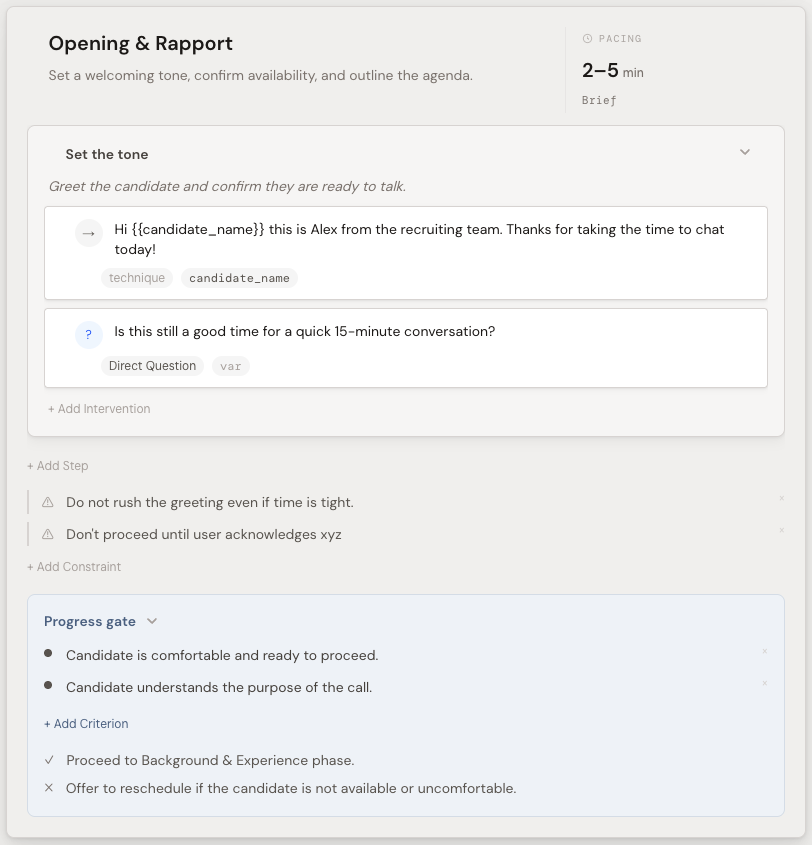
Drag phases onto a timeline. Add the questions, statements, and follow-ups you want the agent to use. No code.
Conversor · Beta
Author the conversation logic your agent runs, then test it against real, varied input. Ship what you've proven, not what you're hoping works.
Private beta · No credit card · Invite-only
The model handles language fine. What breaks is the flow underneath it: the assumption that callers answer on topic, in order, on the first try. Real callers don't. That's the part that has to be tested, and usually isn't.
How it works
Design the flow, then run it against the cases it actually has to handle, one section at a time.
Drag phases onto a timeline. Add the questions, statements, and follow-ups you want the agent to use. No code.
Pick a section and throw scenarios at it: the odd phrasing, the out-of-order answer, the case you're worried about. Change one section, re-test just that section.
When a case fails, you see exactly which part of the flow mishandled it, not just that something went wrong. Fix it and run it again.
Export the finished, tested flow as a prompt for Claude, GPT, or any model. You shipped what you proved, not what you hoped. Pipecat, Parlant, and Vapi are next.
Under the hood
Every phase ends with a Progress Gate: pass criteria and fail criteria, written by you. Run a scenario through it and the gate shows you exactly where the logic held and where it didn't. That's the difference between a call that looks fine and one you've actually proven works.
Who it's for
You're building a conversational voice AI agent. Technical enough to deploy it, not necessarily technical enough, or willing, to hand-code every conversational flow. What has to hold up isn't the model. It's the conversation logic, under real, varied input, not just the happy path from a demo.
Conversor is in private beta. Drop your email and we'll send an invite as seats open.
No credit card. No calendar bookings. Just an invite when your seat opens.
Check your inbox for confirmation. We'll send an invite as soon as your seat opens.
FAQ
Today, Conversor exports a structured system prompt that works with any LLM: Claude, GPT, Gemini, Llama, local models. Direct integrations with voice runtimes (Pipecat, Parlant, Vapi) are on the near-term roadmap.
No. Conversor is a visual editor end-to-end. If you can drag a card and type in a box, you can design a conversation.
Your conversations are scoped to your account. We don't train on your content. Individual accounts today; team workspaces coming.
Free during beta. Pricing will land with general availability.